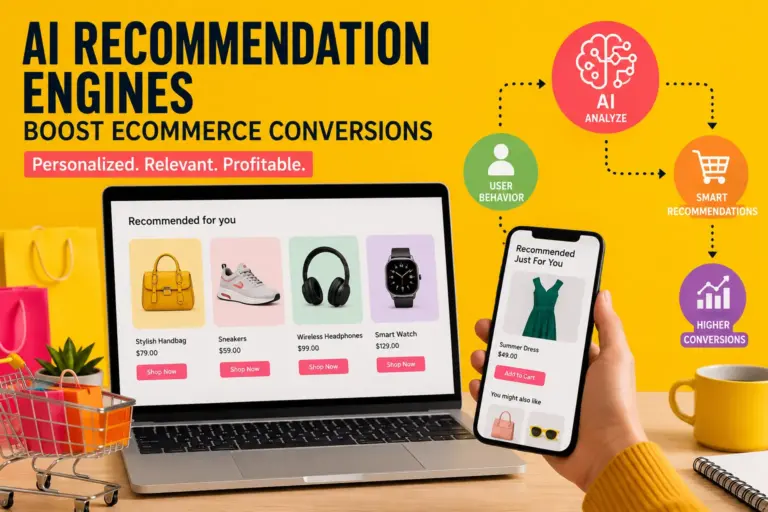
Best AI Ecommerce Tools for Marketing and Sales Growth in 2026
Best AI Ecommerce Tools for Marketing
The ecommerce industry has entered a new phase. Competing on product quality alone isn’t enough anymore. Customer acquisition costs keep rising, paid ads are harder to scale profitably, and shoppers expect personalized experiences across every touchpoint.
That’s where AI ecommerce tools are changing the game.
Modern AI platforms can now optimize product recommendations, automate lifecycle marketing, personalize storefronts, predict buying behavior, improve search relevance, generate ad creatives, recover abandoned carts, and even forecast inventory demand with surprising accuracy.
For ecommerce brands, AI is no longer experimental technology. It’s operational infrastructure.
The businesses growing fastest today are usually doing three things well:
- Automating repetitive marketing tasks
- Improving conversion rates through personalization
- Using customer data more intelligently than competitors
This guide breaks down the best AI ecommerce tools for marketing and sales growth, including real-world use cases, strengths, limitations, and the types of ecommerce businesses each platform fits best.
Why AI Matters More Than Ever in Ecommerce
Online retail has become brutally competitive.
Customer acquisition costs on platforms like Meta Ads and Google Ads have climbed steadily. Consumers bounce quickly. Product catalogs are larger. Expectations around delivery speed and personalization are higher than ever.
AI helps ecommerce businesses solve several expensive problems simultaneously:
- Lower acquisition costs
- Higher average order value (AOV)
- Better customer retention
- Improved onsite conversion rates
- Faster campaign execution
- Smarter merchandising decisions
- More accurate forecasting
Instead of hiring large teams for every optimization task, ecommerce businesses now use AI-powered systems to automate major parts of marketing and operations.
That includes:
- Product description generation
- Email segmentation
- Predictive analytics
- Smart search
- Dynamic pricing
- Conversational support
- Recommendation engines
- Ad creative generation
- Customer behavior analysis
The result? Faster scaling with less operational friction.
What Makes a Great AI Ecommerce Tool?
Not every “AI-powered” platform actually delivers measurable business value.
Some tools simply layer basic automation behind AI branding. Others genuinely improve revenue performance.
The best AI ecommerce tools usually share several characteristics.
Strong Data Integration
AI systems are only as good as the data feeding them.
Top platforms integrate directly with:
- Shopify
- WooCommerce
- BigCommerce
- Magento
- Klaviyo
- Google Analytics 4
- Meta Ads
- CRM systems
- CDPs (Customer Data Platforms)
The more behavioral and transactional data available, the smarter the AI becomes.
Revenue-Focused Optimization
Useful ecommerce AI tools improve metrics that actually matter:
- Conversion rate
- Average order value
- Repeat purchase rate
- Return on ad spend (ROAS)
- Customer lifetime value (LTV)
- Cart recovery rate
Vanity automation isn’t enough.
Real-Time Personalization
Static ecommerce experiences are dying.
Modern shoppers expect:
- Personalized product recommendations
- Smart bundles
- Dynamic offers
- Relevant search results
- Context-aware messaging
AI tools capable of real-time adaptation usually outperform rule-based systems.
Scalability
A small Shopify store and an enterprise retailer have very different needs.
Good platforms scale from:
- Small catalogs
- Multi-store operations
- International ecommerce
- Omnichannel retail
- Enterprise personalization ecosystems
Categories of AI Ecommerce Tools That Drive Growth
Before comparing platforms, it helps to understand where AI creates the biggest commercial impact.
AI Personalization Platforms
These tools analyze shopper behavior to personalize:
- Product recommendations
- Homepage layouts
- Promotions
- Email sequences
- Search results
- Upsells and cross-sells
Examples include Nosto, Dynamic Yield, and Bloomreach.
AI Marketing Automation Tools
These systems automate customer journeys and campaign execution.
Typical features include:
- Predictive segmentation
- Email optimization
- SMS automation
- Send-time optimization
- AI-generated messaging
- Churn prediction
Klaviyo dominates this category for many Shopify brands.
AI Search and Discovery Platforms
Search functionality heavily influences ecommerce conversion rates.
AI search tools improve:
- Search relevance
- Typo tolerance
- Semantic matching
- Product filtering
- Merchandising rules
Algolia and Clerk.io are strong examples.
AI Customer Support Platforms
Conversational AI has evolved far beyond basic FAQ bots.
Modern AI support tools can:
- Handle order tracking
- Recommend products
- Recover carts
- Answer product questions
- Escalate support intelligently
Tidio AI and Gorgias AI are increasingly popular among ecommerce operators.
AI Content and SEO Tools
Content generation has become one of the largest AI use cases in ecommerce.
These tools help create:
- Product descriptions
- SEO pages
- Ad copy
- Blog content
- Email campaigns
- Landing pages
Jasper and Surfer SEO often work together in ecommerce content workflows.
Best AI Ecommerce Tools for Marketing and Sales Growth
1. Shopify Magic
Best For
Shopify-native AI workflows
Key Features
- AI-generated product descriptions
- Automated email generation
- AI sidekick assistant
- Smart customer insights
- Built-in commerce automation
Shopify has aggressively integrated AI directly into its ecosystem. For merchants already using Shopify, Shopify Magic reduces friction dramatically because it’s native to the platform.
Instead of adding multiple third-party apps, store owners can generate descriptions, automate responses, and streamline merchandising from the admin dashboard itself.
Advantages
- Native Shopify integration
- Fast implementation
- Beginner-friendly
- Strong ecosystem compatibility
Drawbacks
- Limited advanced customization
- Less powerful than enterprise AI stacks
Ideal Users
- Small-to-mid-sized Shopify brands
- Fast-growing DTC stores
- Merchants with lean teams
2. Klaviyo AI
Best For
Email and SMS automation
Klaviyo has become almost synonymous with ecommerce lifecycle marketing.
Its AI capabilities now extend into:
- Predictive analytics
- Smart segmentation
- Send-time optimization
- Churn prediction
- Product recommendation blocks
- AI-generated campaign drafts
Why Ecommerce Brands Like It
Retention marketing is often the highest-margin revenue channel in ecommerce.
Klaviyo excels at:
- Abandoned cart recovery
- Post-purchase flows
- Win-back campaigns
- VIP segmentation
- Personalized promotions
For many brands, Klaviyo becomes the central marketing intelligence layer.
Best Use Case
A fashion retailer with repeat customers can use predictive churn modeling to identify likely drop-offs before they happen and automatically trigger retention incentives.
Limitations
- Pricing scales aggressively with list size
- Requires strategic setup to maximize performance
3. Jasper
Best For
AI-generated ecommerce content
Jasper is widely used for:
- Product descriptions
- Paid ad copy
- Blog content
- Landing pages
- Email campaigns
- Marketplace listings
For ecommerce teams managing large catalogs, content generation can become a major bottleneck. Jasper significantly reduces production time.
Where It Performs Well
- Scaling SEO category pages
- Writing Meta ad variations
- Generating seasonal campaign copy
- Multilingual ecommerce content
Important Caveat
AI-generated content still requires human editing.
Brands relying entirely on unedited AI copy often end up with bland, repetitive content that weakens conversion performance.
The best-performing ecommerce brands use Jasper as a productivity multiplier, not a replacement for strategic copywriting.
4. Nosto
Best For
AI personalization and merchandising
Nosto focuses heavily on personalization-driven revenue growth.
Its AI engine analyzes shopper behavior to optimize:
- Product recommendations
- Category sorting
- Personalized content
- Search results
- Merchandising decisions
Why It Matters
Personalization directly affects:
- Conversion rate
- Average order value
- Session duration
- Repeat purchase behavior
A shopper browsing running shoes shouldn’t see generic homepage content. Nosto adapts experiences dynamically.
Strong Use Cases
- Fashion ecommerce
- Beauty brands
- Lifestyle retail
- Large product catalogs
Downsides
- Requires sufficient traffic data
- Advanced implementations may require technical support
5. Dynamic Yield
Best For
Enterprise personalization
Dynamic Yield is a serious enterprise-grade AI optimization platform.
Capabilities include:
- Personalization testing
- Predictive targeting
- Dynamic content delivery
- AI recommendation engines
- Omnichannel optimization
This is the kind of platform used by larger ecommerce organizations managing substantial traffic volumes.
What Makes It Powerful
Dynamic Yield combines:
- Experimentation
- AI targeting
- Behavioral segmentation
- Predictive recommendations
into a unified optimization system.
Best Fit
- Enterprise retailers
- Large omnichannel brands
- International ecommerce operations
6. Algolia AI Search
Best For
AI-powered ecommerce search
Search quality directly impacts revenue.
Poor search experiences create:
- Bounce rates
- Lost conversions
- Frustrated users
- Lower session value
Algolia improves product discovery using:
- Semantic search
- AI ranking
- Typo tolerance
- Personalized search results
- Merchandising controls
Real Ecommerce Impact
Shoppers using site search often convert at significantly higher rates than casual browsers.
AI search optimization can dramatically improve revenue efficiency.
Especially Valuable For
- Large product catalogs
- Electronics retailers
- Auto parts ecommerce
- Specialty marketplaces
7. Rebuy
Best For
AI upsells and cart optimization
Rebuy specializes in revenue expansion through:
- Smart upsells
- Cross-sells
- Personalized cart offers
- Subscription optimization
- Checkout recommendations
Why It Works
Increasing average order value is often cheaper than acquiring new customers.
Rebuy helps stores maximize existing purchase intent.
Common Use Cases
- Subscription products
- Beauty ecommerce
- Supplement brands
- Consumer packaged goods
Standout Feature
Its post-purchase optimization flows can increase revenue without harming conversion rates.
8. Tidio AI
Best For
AI customer support automation
Customer support has become a major operational expense for ecommerce businesses.
Tidio uses conversational AI to automate:
- Order tracking
- FAQs
- Product recommendations
- Lead capture
- Live chat escalation
Why It’s Useful
Fast support responses improve:
- Conversion trust
- Customer satisfaction
- Retention
- Purchase confidence
Particularly Helpful For
- Small ecommerce teams
- International stores
- Stores with high support volume
9. Surfer SEO
Best For
Ecommerce SEO content optimization
Organic traffic remains one of the most profitable acquisition channels.
Surfer helps ecommerce brands optimize:
- Category pages
- Blog content
- Product collection pages
- Buying guides
- Comparison articles
Key Advantage
It combines NLP analysis with competitive SEO data to improve semantic relevance.
Best Ecommerce Applications
- SEO-driven Shopify brands
- Affiliate ecommerce
- Content-heavy ecommerce businesses
10. AdCreative.ai
Best For
AI ad creative generation
Paid social campaigns require endless creative testing.
AdCreative.ai generates:
- Banner ads
- Social creatives
- Ad copy
- Product-focused creatives
- Conversion-oriented layouts
Why Marketers Use It
Creative fatigue kills ROAS.
AI-assisted creative production allows faster testing cycles.
Useful For
- Meta advertisers
- TikTok ecommerce campaigns
- Rapid product launches
11. Manychat
Best For
Conversational ecommerce marketing
Manychat combines automation with messaging channels like:
- Instagram DM automation
- Facebook Messenger
- WhatsApp automation
Ecommerce Benefits
- Recover abandoned carts
- Capture leads
- Answer product questions
- Run conversational promotions
Why It’s Growing
Social commerce continues expanding rapidly, especially for DTC brands.
12. Clerk.io
Best For
AI product recommendations and search
Clerk.io combines:
- Search optimization
- Product recommendations
- Email personalization
Its machine learning engine adapts based on shopper behavior.
Strong Use Cases
- Mid-sized ecommerce stores
- Multi-category catalogs
- Personalized merchandising
13. Bloomreach
Best For
AI-driven commerce experience orchestration
Bloomreach is designed for sophisticated ecommerce ecosystems.
Features include:
- AI search
- Personalized merchandising
- Customer data activation
- Omnichannel personalization
- Predictive segmentation
Enterprise Strength
Bloomreach excels when ecommerce businesses need unified customer intelligence across channels.
14. ChatGPT for Ecommerce Workflows
Best For
Flexible ecommerce AI operations
Many ecommerce businesses now integrate ChatGPT into internal workflows for:
- Product copy
- Customer support drafts
- Market research
- FAQ generation
- SEO ideation
- Ad variations
- Customer segmentation ideas
Important Reality
ChatGPT works best when paired with human expertise and structured workflows.
The highest-performing ecommerce teams combine AI speed with experienced strategic oversight.
How AI Improves Ecommerce Conversion Rates
AI tools influence conversion optimization in several ways.
Personalized Product Recommendations
Recommendation engines increase relevance.
Instead of generic catalogs, shoppers see:
- Frequently bought together products
- Personalized bundles
- Behavior-based recommendations
Amazon helped normalize this behavior years ago. Consumers now expect it.
Smart Search Optimization
AI search reduces friction during product discovery.
Better search means:
- Faster product discovery
- Fewer exits
- More product views
- Higher purchase intent
Dynamic Merchandising
AI systems can automatically:
- Promote trending products
- Highlight high-margin items
- Adjust category rankings
- Optimize homepage layouts
This creates continuously evolving storefront optimization.
Behavioral Triggering
AI marketing automation tools detect buying intent patterns.
For example:
- Exit intent
- Cart abandonment
- Repeat browsing
- Price sensitivity signals
These triggers improve timing and relevance.
AI Customer Acquisition Strategies for Ecommerce
Customer acquisition has become more expensive across nearly every paid channel.
AI helps improve efficiency in several ways.
Predictive Audience Targeting
AI platforms analyze high-value customers and identify similar behavioral patterns.
This improves:
- Paid ad targeting
- Lookalike audiences
- Creative relevance
- Bid optimization
AI Creative Testing
Modern ad platforms reward creative velocity.
AI-generated creative testing helps marketers rapidly iterate:
- Headlines
- Product hooks
- Visual combinations
- Promotional angles
SEO Content Scaling
Organic traffic compounds over time.
AI content workflows help ecommerce brands create:
- Buying guides
- Comparison content
- Long-tail landing pages
- Category optimization content
at scale.
AI for Ecommerce Retention and Customer Lifetime Value
Retention is where ecommerce profitability often lives.
Acquiring customers repeatedly through paid ads becomes expensive fast.
AI improves retention through:
- Predictive churn modeling
- Personalized recommendations
- Automated replenishment reminders
- Loyalty segmentation
- Smart discount timing
A supplement brand, for example, can use AI to predict when customers are likely running low and trigger replenishment campaigns automatically.
That creates operational efficiency while increasing lifetime value.
Common Mistakes Ecommerce Businesses Make With AI
Buying Too Many Tools
Stack fragmentation becomes a real problem.
Too many disconnected AI apps create:
- Data silos
- Tracking issues
- Slow storefronts
- Operational complexity
Integration quality matters more than tool quantity.
Ignoring Data Quality
AI systems trained on poor customer data produce weak outcomes.
Common issues include:
- Duplicate profiles
- Incomplete attribution
- Poor event tracking
- Inaccurate segmentation
Clean data infrastructure is foundational.
Over-Automating Customer Experience
Customers still value human interaction.
Brands that over-automate messaging often sound robotic and generic.
AI should enhance personalization, not eliminate authenticity.
Expecting Instant Results
Most AI systems improve over time as they collect behavioral data.
Optimization is iterative.
How to Choose the Right AI Ecommerce Platform
The best platform depends heavily on:
- Store size
- Traffic volume
- Technical resources
- Growth stage
- Product catalog complexity
- Marketing sophistication
Small Ecommerce Stores
Focus on:
- Shopify Magic
- Klaviyo
- Tidio
- Jasper
These tools deliver relatively fast ROI with lower implementation complexity.
Mid-Market Ecommerce Brands
Look at:
- Rebuy
- Nosto
- Algolia
- Surfer SEO
These improve personalization and acquisition efficiency.
Enterprise Ecommerce Operations
Consider:
- Dynamic Yield
- Bloomreach
- Advanced CDPs
- Omnichannel AI stacks
Enterprise AI requires more operational maturity but delivers substantial personalization advantages.
AI Ecommerce Trends Shaping 2026 and Beyond
Conversational Commerce
AI assistants are becoming integrated into shopping experiences directly.
Expect growth in:
- AI shopping agents
- Voice commerce
- Conversational product discovery
Predictive Commerce
Retailers increasingly use AI to anticipate demand before customers explicitly express it.
This affects:
- Inventory planning
- Merchandising
- Promotions
- Fulfillment
AI-Generated Visual Commerce
Generative AI is transforming ecommerce visuals through:
- AI-generated product imagery
- Virtual try-ons
- Synthetic lifestyle photography
Hyper-Personalization
The future of ecommerce is highly individualized experiences.
Static storefronts will likely become less effective over time.
FAQ
What are the best AI ecommerce tools for Shopify stores?
Popular Shopify-focused AI tools include Shopify Magic, Klaviyo, Rebuy, Tidio, and Nosto. These integrate well with Shopify workflows and help improve automation, personalization, and conversion optimization.
Can AI improve ecommerce conversion rates?
Yes. AI improves conversion rates through personalized recommendations, smarter search, behavioral targeting, optimized merchandising, and automated customer engagement.
Which AI tool is best for ecommerce marketing automation?
Klaviyo remains one of the strongest ecommerce marketing automation platforms due to its predictive segmentation, email automation, and ecommerce-native integrations.
Are AI ecommerce tools expensive?
Pricing varies widely. Some tools charge based on traffic volume, while others scale based on customer lists or feature usage. Small businesses can start with lower-cost AI solutions before moving into enterprise platforms.
Does AI help with ecommerce SEO?
Absolutely. AI SEO tools help optimize category pages, generate content ideas, improve semantic relevance, and scale long-tail search content efficiently.
What’s the biggest benefit of AI in ecommerce?
For most ecommerce businesses, the biggest advantage is operational leverage. AI allows teams to personalize customer experiences and optimize marketing performance without proportionally increasing headcount.
Conclusion
AI ecommerce tools are no longer optional growth experiments. They’ve become central to how modern online stores compete.
The most effective ecommerce businesses now combine:
- AI-driven personalization
- Automated lifecycle marketing
- Predictive analytics
- Intelligent search
- Conversational support
- Content automation
But technology alone isn’t enough.
The stores seeing the strongest results usually treat AI as an amplifier for good strategy, clean data, and strong customer experience design — not as a shortcut around them.
Choosing the best AI ecommerce tools depends less on hype and more on operational fit, customer behavior, and revenue goals.
Done well, AI can improve acquisition efficiency, increase average order value, strengthen retention, and create ecommerce experiences that feel significantly more relevant to customers.