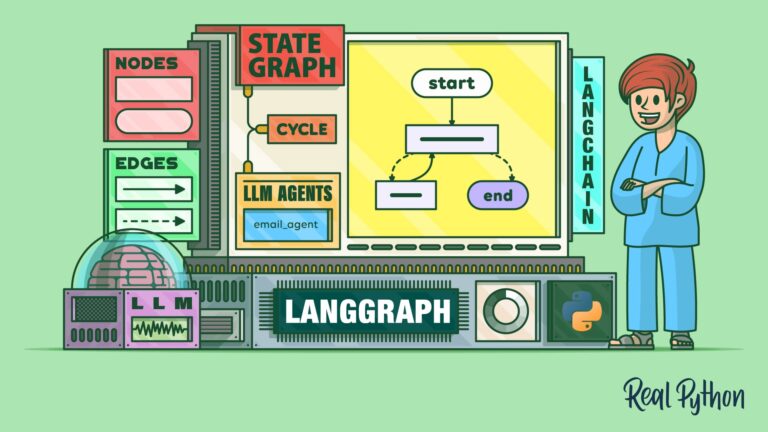
Qt Designer and Python: Build Your GUI Applications Faster
Qt Designer is a tool that lets you build the graphical user interface (GUI) of a PyQt application visually, by dragging and dropping widgets onto a form instead of writing layout code by hand. In Python, you save those designs as .ui files and load them into your apps, which can speed up your GUI development considerably.
By the end of this tutorial, you’ll understand that:
- Qt Designer produces XML-based
.uifiles that don’t depend on a particular Qt binding, so you build your GUI visually and then use it from PyQt6 code. - You install the PyQt6 bindings with
pip install pyqt6and get the Qt Designer app from PySide6, your system package manager, or the official Qt installer. - The
pyuic6command turns a.uifile into a Python module, whileuic.loadUi()reads the same file at runtime. - A single Qt Designer form can hold a complete main window with menus, toolbars, and a status bar, or a standalone dialog.
- You connect a widget’s signals to slots visually in Qt Designer, without hand-writing the connection code.
You’ll also see when it makes sense to reach for Qt Designer instead of hand coding your GUIs in plain Python.
For a better understanding of the topics in this tutorial, you can check out the following resources:
- Python and PyQt: Building a GUI Desktop Calculator
- Python and PyQt: Creating Menus, Toolbars, and Status Bars
- PyQt Layouts: Create Professional-Looking GUI Applications
You’ll put all this knowledge together by using the GUIs that you’ll build with Qt Designer in a sample text editor application. You can get the code and all the required resources to build this application by clicking the link below:
Get the Source Code: Click here to get the source code you’ll use to learn about creating Python GUI applications with Qt Designer in this tutorial.
Take the Quiz: Test your knowledge with our interactive “Qt Designer and Python: Build Your GUI Applications Faster” quiz. You’ll receive a score upon completion to help you track your learning progress:
Interactive Quiz
Qt Designer and Python: Build Your GUI Applications Faster
Test your knowledge of Qt Designer for Python. Build PyQt GUIs visually with drag-and-drop, signals and slots, and .ui files.
Getting Started With Qt Designer
Qt Designer is a Qt tool that provides you with a what-you-see-is-what-you-get (WYSIWYG) user interface to create GUIs for your PyQt applications productively and efficiently. With this tool, you create GUIs by dragging and dropping QWidget objects on an empty form. After that, you can arrange them into a coherent GUI using different layout managers.
Qt Designer also allows you to preview your GUIs using different styles and resolutions, connect signals and slots, create menus and toolbars, and more.
Qt Designer is platform and programming language independent. It doesn’t produce code in any particular programming language, but it creates .ui files. These files are XML files with detailed descriptions of how to generate Qt-based GUIs.
You can translate the content of .ui files into Python code with pyuic6, which is a command-line tool that comes with PyQt. Then you can use this Python code in your GUI applications. You can also read .ui files directly and load their content to generate the associated GUI.
Installing and Running Qt Designer
There are several ways to install Qt Designer, and the right one depends on your platform. Qt Designer is a separate application, so you’ll set up two separate pieces: the PyQt6 bindings that your code will use, and the Qt Designer application itself.
First, create and activate a Python virtual environment and install PyQt6 with pip:
$ python3 -m venv ./venv
$ source venv/bin/activate
(venv) $ python -m pip install pyqt6
This installs PyQt6 along with a private copy of the required Qt libraries. It also gives you pyuic6, a command-line tool that you’ll use later to turn your .ui files into Python code.
Note: In PyQt5, you installed Qt Designer through the pyqt5-tools package. In PyQt6, pyqt6-tools is no longer maintained and won’t install on current Python versions, so you’ll install Qt Designer on its own instead.
Next, install the Qt Designer application. Because Qt Designer saves its work in binding-agnostic .ui files, you can get the tool in whatever way is most convenient for your platform.
Even though your application code uses PyQt6, the quickest cross-platform way to get Qt Designer is to install PySide6, which ships with a ready-to-run copy of the tool:
(venv) $ python -m pip install pyside6
(venv) $ pyside6-designer
The pyside6-designer command launches the same Qt Designer that you’d get directly from Qt. You design your GUI here and then load the resulting .ui file from PyQt6.
You can also install Qt Designer in a few platform-specific ways:
Read the full article at »
[ Improve Your Python With 🐍 Python Tricks 💌 – Get a short & sweet Python Trick delivered to your inbox every couple of days. >> Click here to learn more and see examples ]