GPT-5.6 Sol vs. Claude Fable 5: Benchmarks, Pricing & Hands-On
GPT-5.6 Sol and Claude Fable 5 are currently fighting for the frontier-model crown.
Fable 5 holds a slight edge in general intelligence, while Sol hits back with stronger coding performance, faster execution and much lower pricing. In fact, GPT-5.6 Sol is priced closer to Claude Opus 4.8 than to Fable 5, which makes this comparison even more interesting.
One model promises deeper reasoning. The other offers near-frontier performance at a far more practical cost.
So, which model should you actually use?
What is GPT-5.6 Sol?
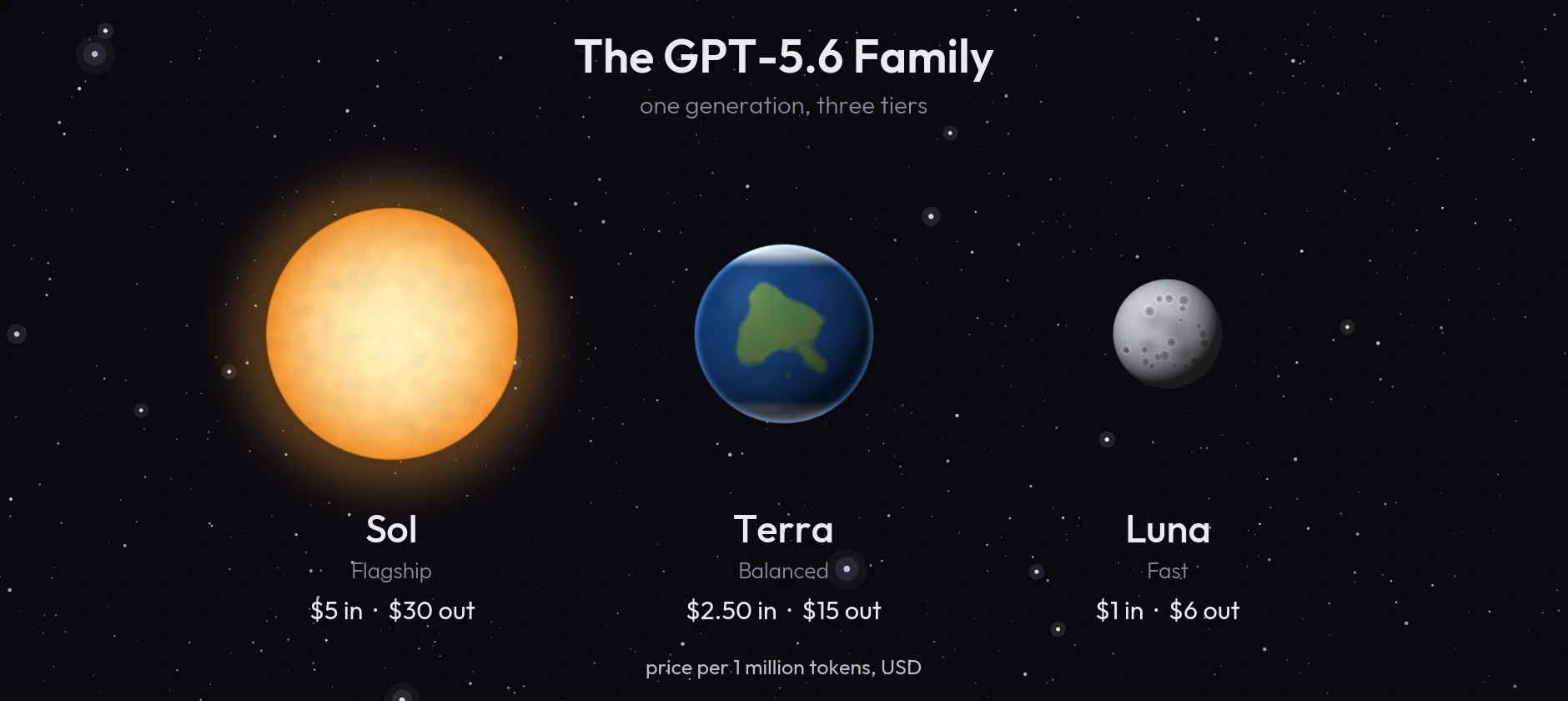
GPT-5.6 Sol is OpenAI’s flagship model for coding, research, tool use and complex professional workflows.
For tougher problems, it supports max reasoning, allowing the model to spend more compute before answering. Its ultra mode goes a step further by deploying multiple agents in parallel, making it better suited to large coding tasks, deep research and multi-step projects.
Read more: GPT-5.6: Sol, Terra, and Luna
What is Claude Fable 5?

Claude Fable 5 is Anthropic’s most capable publicly available model, built for complex reasoning and long-running agentic work.
Inside Claude Code or Managed Agents, it can plan multi-step tasks, delegate work to sub-agents, review intermediate results and refine its own output. That makes it especially useful for large coding projects, deep research and assignments that require less human supervision.
Read more: Fable 5: Myth(os) or Reality
Pricing Comparison
API prices per million tokens:
| Model | Input | Cached Input | Output |
|---|---|---|---|
| GPT-5.6 Sol | $5 | $0.50 | $30 |
| Claude Fable 5 | $10 | $1 | $50 |
Sol costs half as much for input and 40% less for output.
Both models offer roughly one million tokens of context and up to 128,000 output tokens. Sol’s context window is slightly larger at 1.05 million tokens.
There is one catch. Sol requests crossing 272,000 input tokens receive higher pricing for the entire request.
Pricing winner: GPT-5.6 Sol
For normal workloads, it is not close. Not only Sol has a higher limit but also offers free to use token resets occasionally:
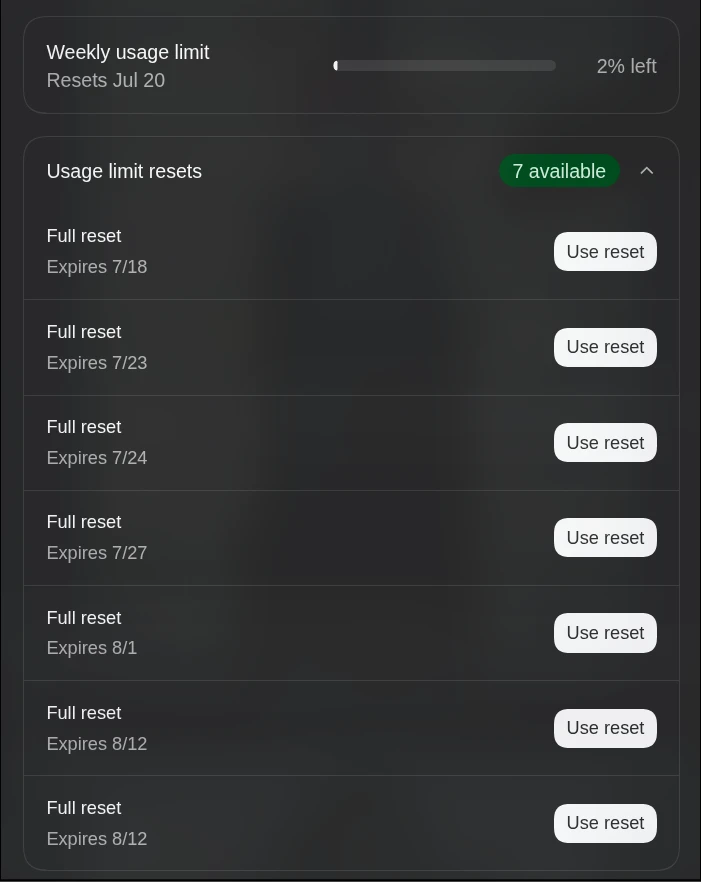
Something that Anthropic can clearly learn!
Hands-On Comparison
To compare GPT-5.6 Sol and Claude Fable 5 fairly, I used the same prompt, fresh chats and default reasoning settings for both models.
The outputs were judged on instruction following, correctness, completeness and presentation.
Test 1: Build a Web Application
This test checks frontend coding, design quality and functional completeness.
Prompt:
Build a responsive personal finance dashboard as a single HTML file.Requirements:
- Use only HTML, CSS and vanilla JavaScript
- Include cards for income, expenses, savings and investments
- Add an interactive monthly spending chart
- Add a transaction table with search and category filters
- Include light and dark modes
- Use realistic sample data
- Make the design clean and suitable for a modern fintech product
- Return the complete working code in one file
GPT 5.6 Sol Response:
It took the model 6 minutes and 30 seconds to respond with the desired webpage. Here it is:
Claude Fable 5 Response:
It took the model 3 minutes and 10 seconds to respond with the desired webpage. Here it is:
Test 2: Data Analysis and Business Reasoning
This test checks analytical depth, numerical accuracy and the ability to produce useful recommendations.
Prompt:
You are a senior data analyst reviewing the quarterly performance of an e-commerce company.Quarterly data:
Q1:
Revenue: $2.4 million
Orders: 48,000
Conversion rate: 2.8%
Customer acquisition cost: $31
Repeat purchase rate: 22%Q2:
Revenue: $2.7 million
Orders: 51,000
Conversion rate: 3.1%
Customer acquisition cost: $36
Repeat purchase rate: 24%Q3:
Revenue: $2.9 million
Orders: 54,000
Conversion rate: 3.4%
Customer acquisition cost: $43
Repeat purchase rate: 23%Q4:
Revenue: $3.1 million
Orders: 56,000
Conversion rate: 3.3%
Customer acquisition cost: $51
Repeat purchase rate: 20%
Analyse the company’s performance.Include:
- The three most important trends
- Any warning signs
- Likely causes behind the changes
- Five actions the company should take next quarter
- A concise executive summaryDo not simply repeat the numbers. Derive useful business insights from them.
GPT 5.6 Sol Response:
The model took 1 minute and 20 seconds to respond with:
Click here to view the full response

Claude Fable 5 Response:
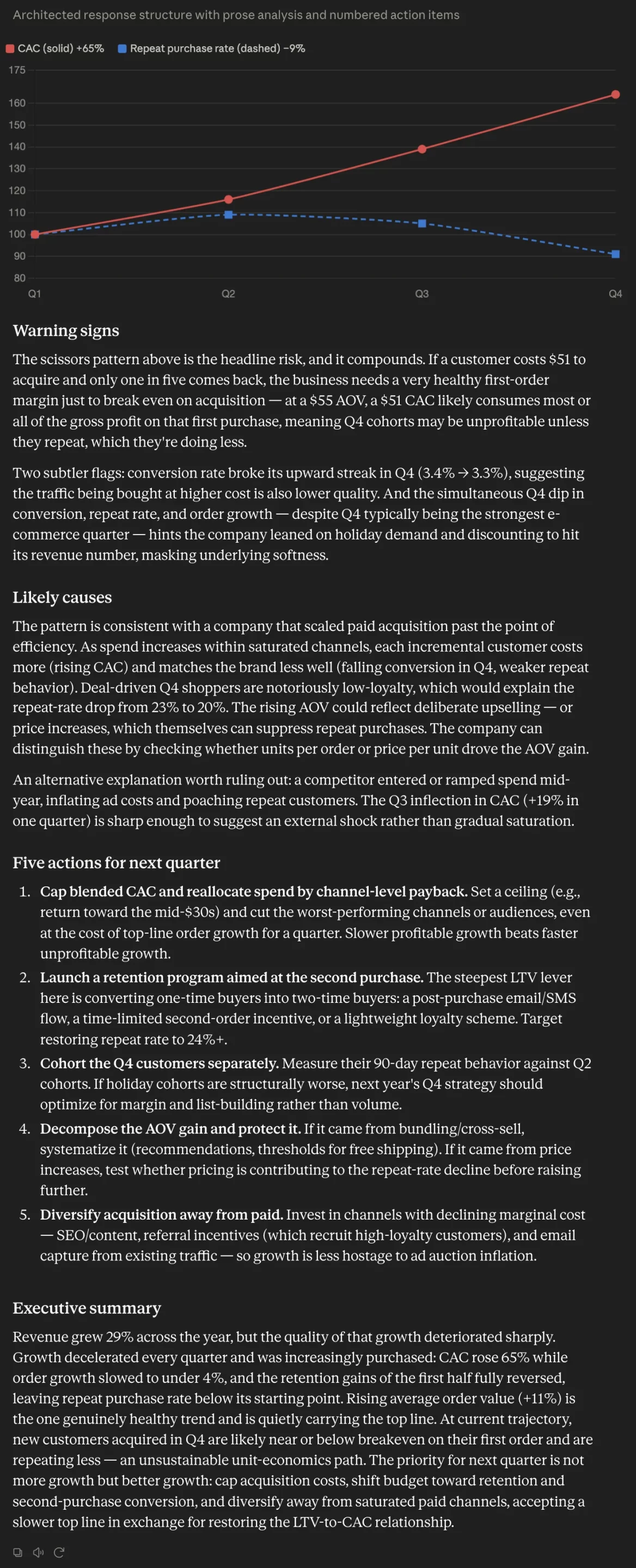
The model took a minute to respond with:
Click here to view the full response
Test 3: Presentation Creation
This test checks content structure, visual judgement and the quality of professional deliverables.
Prompt:
Create an eight-slide investor presentation for an AI-powered recruitment platform.The platform:
- Screens job applications
- Matches candidates with suitable roles
- Generates structured interview questions
- Provides hiring analytics
- Targets mid-sized technology companiesInclude:
1. Title slide
2. Problem
3. Solution
4. Product workflow
5. Market opportunity
6. Business model
7. Competitive advantage
8. Closing slideUse realistic sample numbers where required.
GPT 5.6 Sol Response:
It took Sol 4 minutes and 38 seconds to respond to the query with:
Claude Fable 5 Response:
It took Fable 5, 2 minutes and 30 seconds to respond to the query with:
Verdict
The biggest difference between the two has to be the usage limits. GPT 5.6 Sol never ran out of usage, regardless of how long I had used it for. Claude Fable 5 on the other hand, hog’d through the usage limit. 3-4 conversations and I was greeted with:

Considering the fact that Fable 5 is available till 19 July whereas Sol is there permanently for all the paid users and that the pricing of Fable 5 is 2-3 times. But it does take its time. I mean a lot of time!
On an average it took sol twice the time it took Fable 5 for responding to the same query (with comparable response quality).
GPT-5.6 Sol vs Claude Fable 5: Benchmarks
Claude Fable 5 has a narrow edge in general intelligence, but GPT-5.6 Sol is the stronger coding agent.
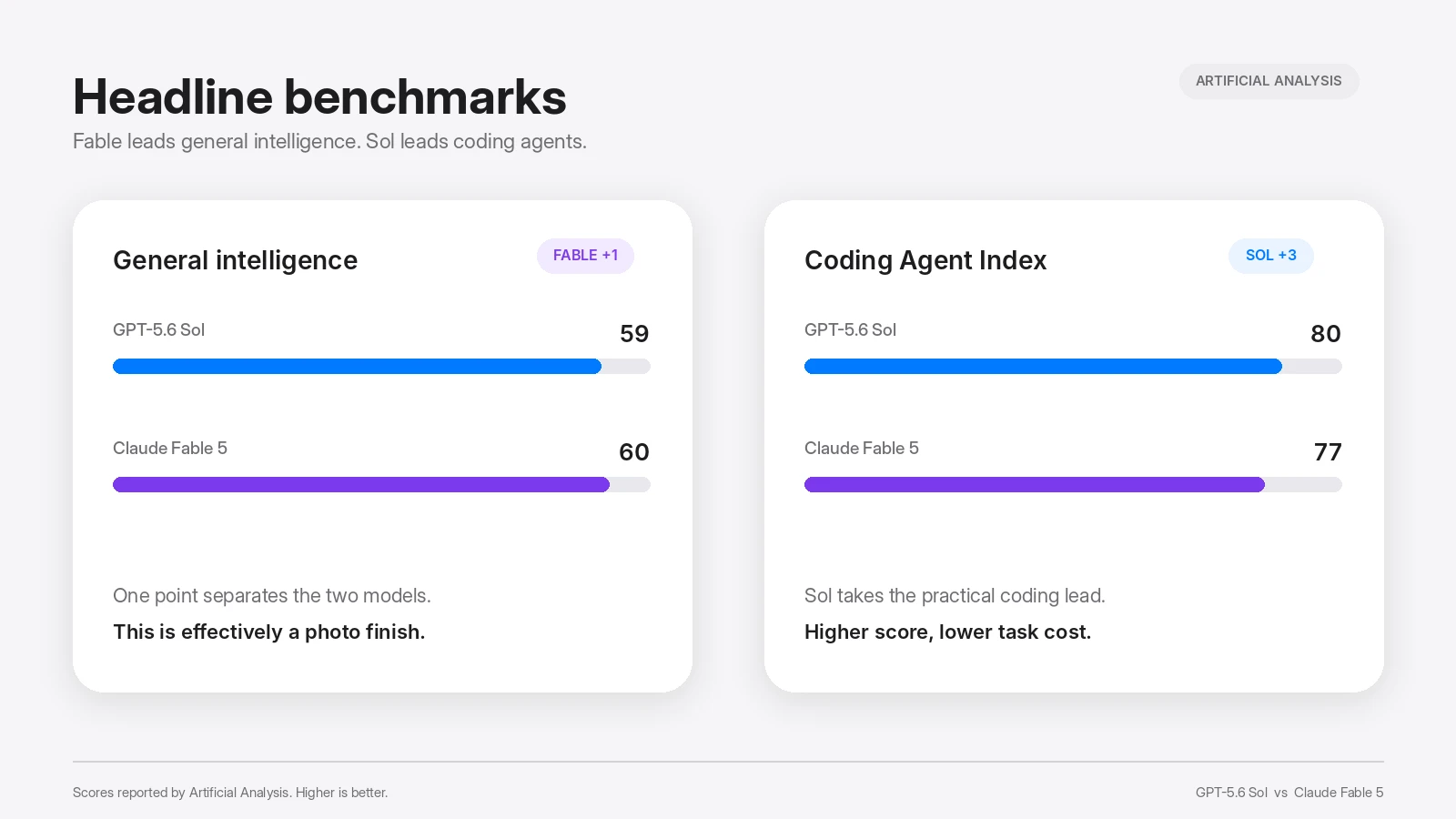
The headline results are split. Fable leads the Artificial Analysis Intelligence Index by one point, while Sol holds a three-point advantage on the Coding Agent Index. For general reasoning, the models are effectively neck and neck. For practical software-development work, Sol has the clearer lead.
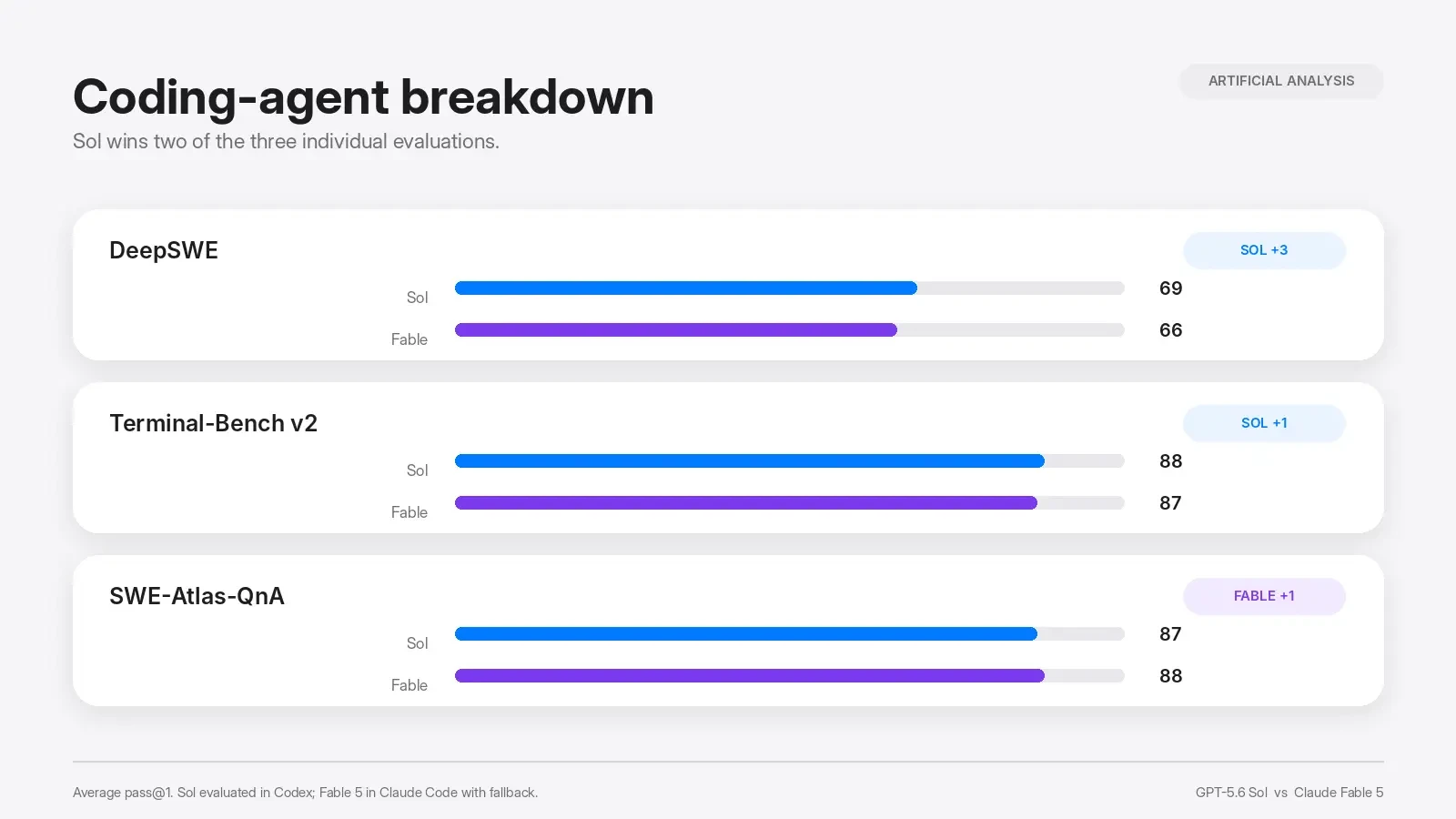
Sol wins more coding evaluations
Sol leads on DeepSWE and Terminal-Bench v2, while Fable finishes one point ahead on SWE-Atlas-QnA. Winning two of the three individual evaluations gives Sol the stronger overall coding-agent profile.
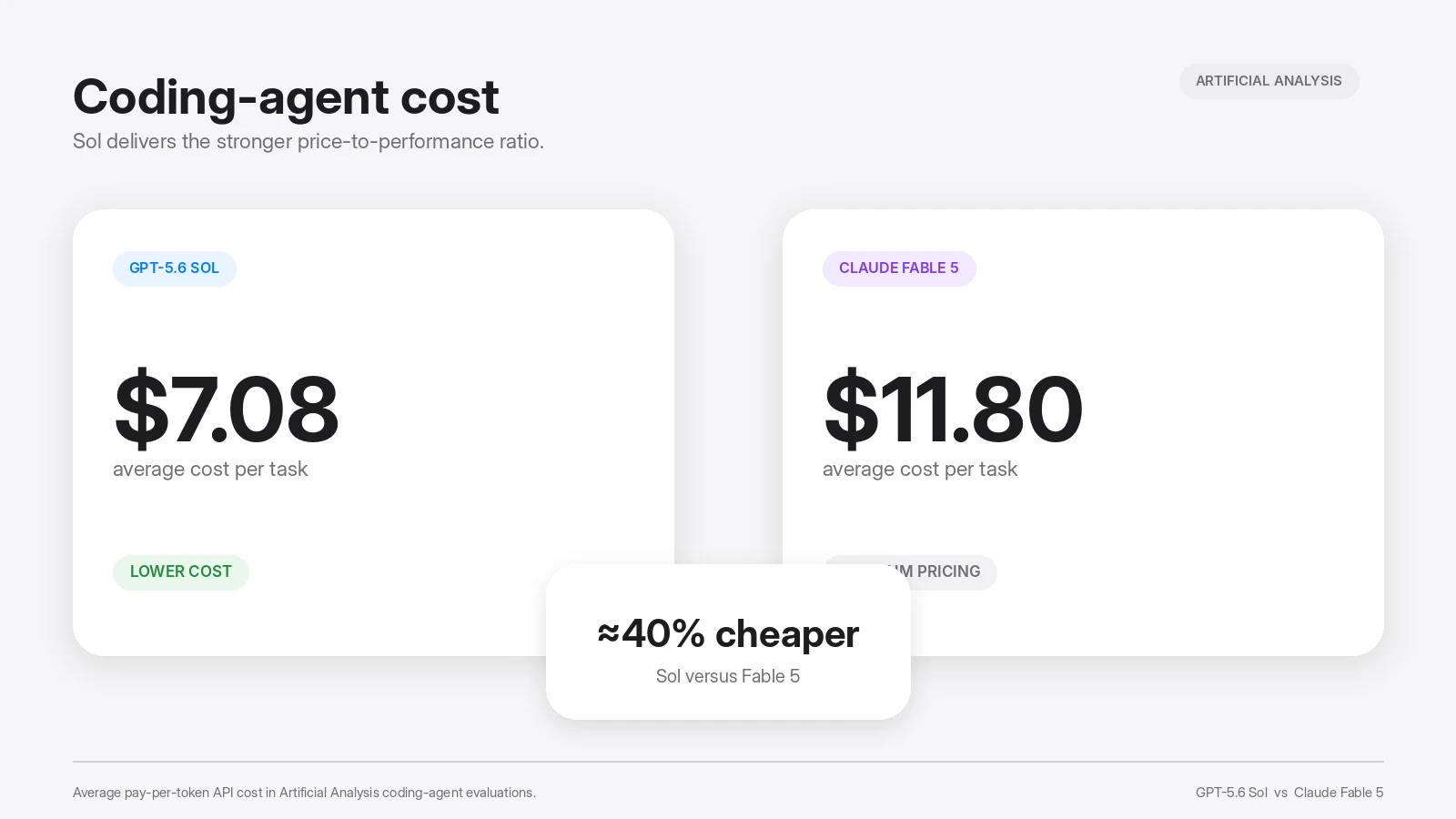
Better performance at a lower cost
Sol’s average evaluation cost is $7.08 per task, compared with $11.80 for Fable 5. That makes Sol roughly 40% cheaper, strengthening its advantage for teams running coding agents at scale.
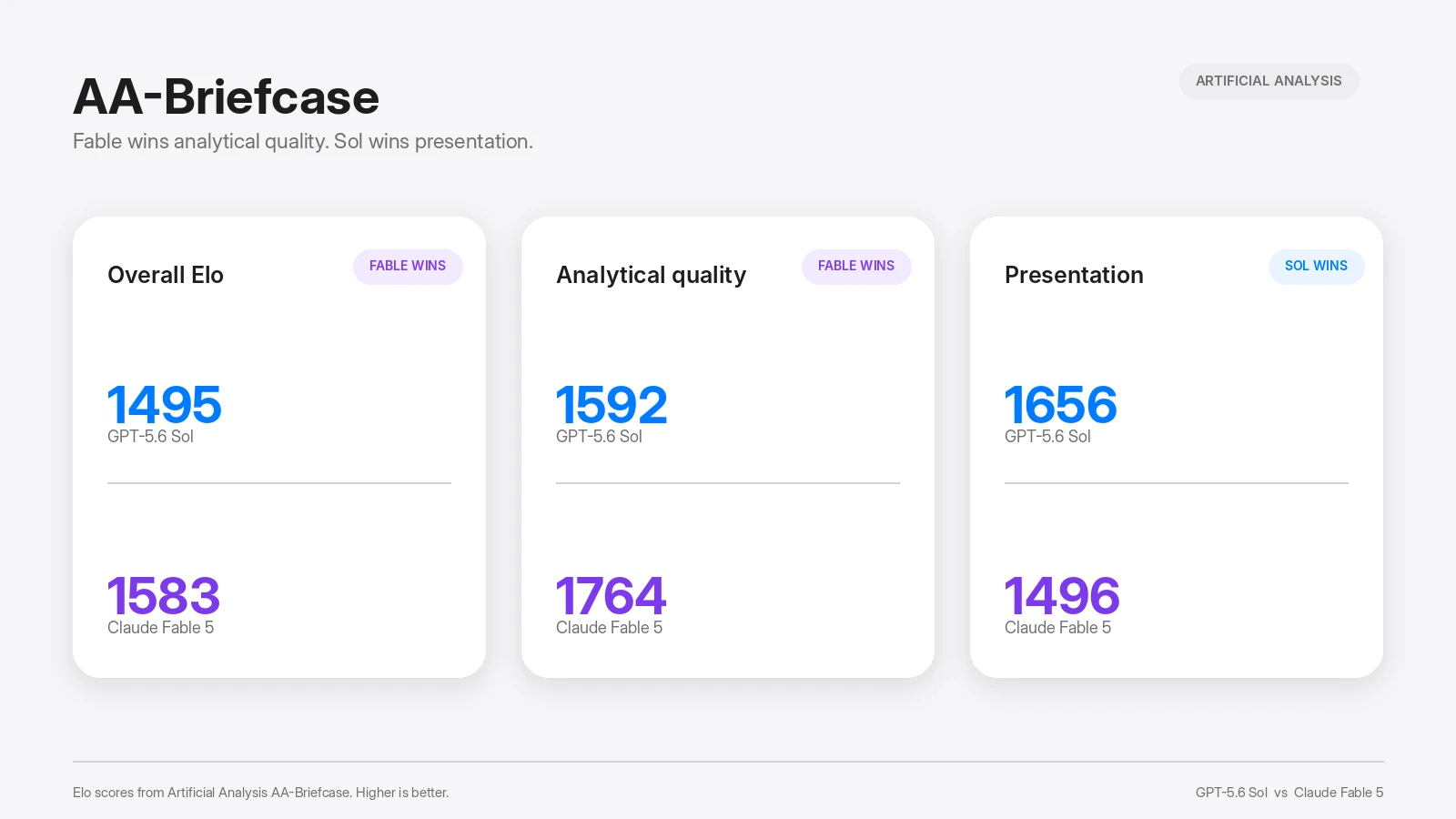
Fable analyzes better but Sol presents better
AA-Briefcase shows a more nuanced result. Fable earns the higher overall Elo score and leads clearly in analytical quality. Sol, however, scores substantially higher on presentation, suggesting it is better at turning its work into clear, usable outputs.
Conclusion
Here’s what became clear:
- GPT-5.6 Sol is slower but cheaper.
- Claude Fable 5 is better at long, complex assignments.
- Sol responds well to feedback and iteration.
- Fable requires less supervision once the task is defined.
For most users, GPT-5.6 Sol is the better choice. It comes close to Fable’s intelligence while offering better coding performance at a much lower cost.
Choose Claude Fable 5 when the work is complex enough to justify the extra expense, especially when you want to hand over a project and return later.
The simplest way to put it:
Sol is the model you work with. Fable is the model you hand work to.
Frequently Asked Questions
GPT-5.6 Sol is better for coding, speed and cost. Fable 5 is better for complex, long-running projects requiring greater autonomy.
GPT-5.6 Sol. It costs $5 per million input tokens and $30 per million output tokens, compared with Fable 5’s $10 and $50.
GPT-5.6 Sol currently leads major independent coding-agent benchmarks. Fable 5 remains useful for planning, architecture and reviewing complex implementations.

I specialize in reviewing and refining AI-driven research, technical documentation, and content related to emerging AI technologies. My experience spans AI model training, data analysis, and information retrieval, allowing me to craft content that is both technically accurate and accessible.
Login to continue reading and enjoy expert-curated content.