Unified context: The missing layer for enterprise AI coworkers
AI assistants are quickly spreading across the surface layer of work. They draft emails, summarize meetings, and answer questions with impressive fluency. But in the places where businesses actually run, such as forecast calls, deal reviews, and operational standups, they rarely change outcomes.
The problem is twofold. First, the context that business decisions depend on is scattered across systems, teams, and definitions. No one sees quite the same version of the business, whether it’s a CMO looking at campaign results or a CFO reviewing quarterly performance. Second, most AI assistants weren’t built for this kind of work. They’re effective at quick, self‑contained tasks like searching a code base but they struggle to follow data, definitions, and workflows across systems and business processes.
What makes context decision-ready
Most companies already have the data they need: CRM records, dashboards, spreadsheets, and a constant stream of signals from across the business. The issue isn’t access. It’s that these pieces don’t line up into a single, trusted view, so teams struggle to get accurate and consistent insights.
Decision-ready context means more than having data in one place. It’s a shared map that provides a clear, connected picture of how the business works. When that map exists, teams can work from the same definitions and follow how a number is built. In a forecast call, for example, a sales leader can see how today’s pipeline ties to product usage, open support issues, and account history in a single view, instead of trying to stitch those signals together manually.
Without that shared context, teams spend time reconciling numbers, debating definitions, and jumping between tools to figure out which deals are real and which are at risk. The question is rarely “do we have the data?” It’s whether that data can be interpreted together, with enough consistency and accuracy, to change the decision.
Why generic assistants fall short
Most general-purpose assistants are designed to interpret a prompt, retrieve what is easiest to access, and produce a fluent and confident response. While that’s sufficient for many business productivity tasks, business users quickly feel the limits because most modern business work is really data work. Ahead of a forecast call, a sales leader might ask a generic assistant which deals are most likely to close. The assistant can scan the CRM and return a neat list based on stage and recent activity, but it won’t automatically factor in product usage trends, open support issues, or changes in account plans. It helps with one slice of the picture at a time—usually whatever has been explicitly given to it—so its answers can sound confident without being reliably grounded in the full context the decision depends on.
Put unified context to work with Genie One
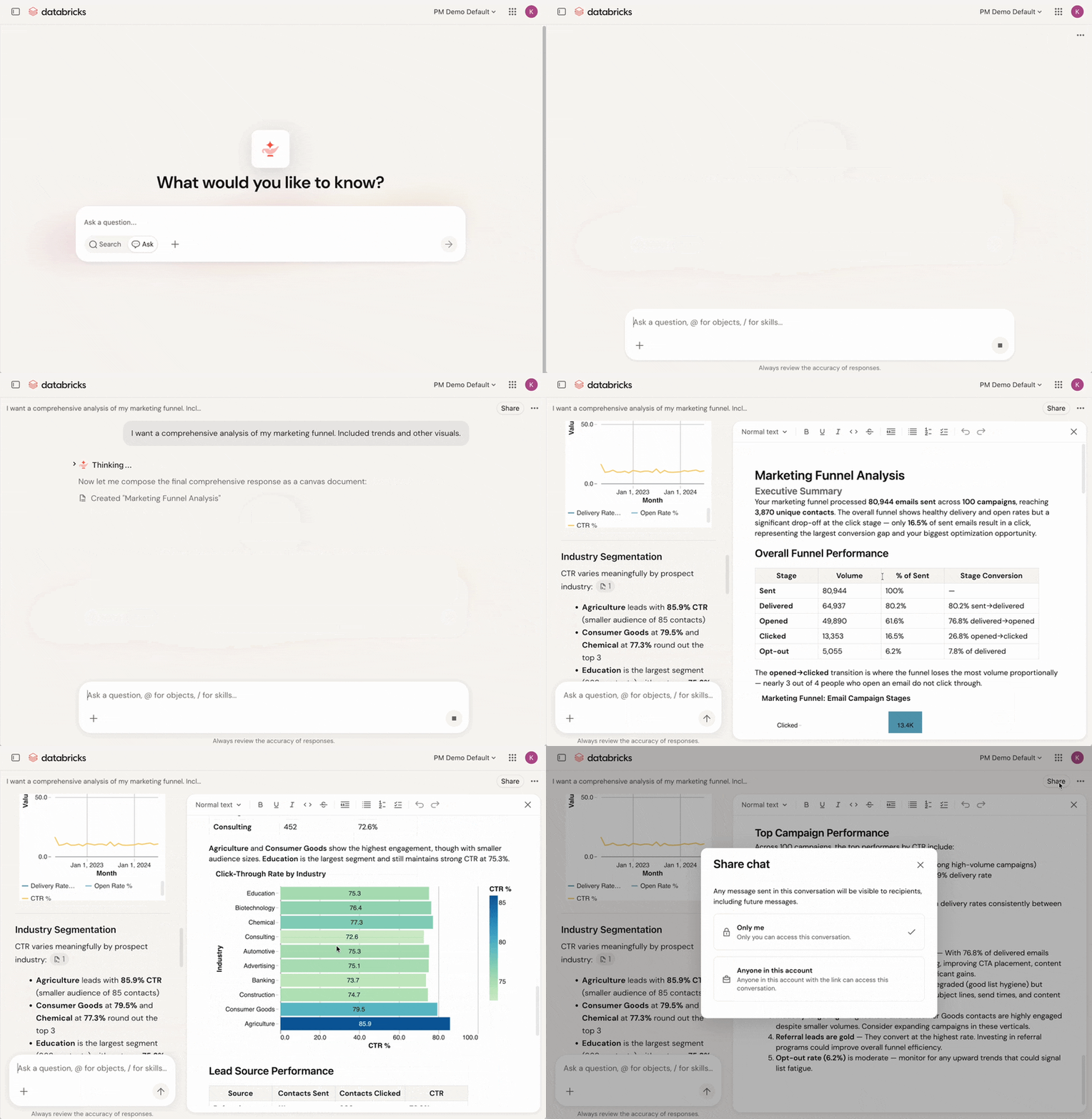
Genie One is the AI assistant for data-driven work that runs on unified context. Rather than treating each question as a standalone interaction, Genie One uses a shared context layer that spans Databricks data, documents, SaaS applications, and operational systems. The point is not simply to answer faster. It’s to let business users ask questions, interpret accurate answers in business terms, and carry that understanding reliably into follow‑up work without reconstructing the backstory each time.
Ask once, where the work happens: Genie One brings unified context into the tools where people already work. This means business users can ask questions in tools like Slack, Microsoft Teams, mobile, MCP, or dashboards and get answers and insights grounded in governed, real-time data.
From insights into actions: Genie One provides agentic cowork capabilities so users can schedule tasks, draft documents, generate reports, and trigger workflows in connected tools. Through Genie One, they can also create agents that turn recurring use cases, like forecast prep, QBR packets, or escalation workflows, into shareable agents that automate those tasks.
Apply governance automatically: Answers, actions, and agents inherit permissions and governance controls from the business, keeping everything aligned with existing access rules and oversight.
Together, that adds up to a lower cost of getting to a decision: less time reconciling numbers before every meeting, fewer fragmented tools to stitch together, and decisions that move from days to minutes without trading off accuracy or control.
A living business context layer
At the center of this approach is Genie Ontology, a unified context layer that reflects how the business actually operates, not just how data is stored. It learns from data, dashboards, queries, documents, and connected applications, then organizes business terms, metrics, entities, and relationships into a living knowledge graph.
That matters because context in enterprises isn’t static. Definitions evolve, ownership shifts, and new signals emerge. Genie Ontology ranks definitions and signals using factors such as usage and links to certified assets, which helps determine what should count as authoritative in a given situation.
Consider a marketing leader asking which campaigns are truly driving the pipeline. A useful answer can’t stop at top-of-funnel metrics. It has to connect campaigns to segments, channels, opportunities in the CRM, closed-won revenue, and downstream product usage, then explain the result in the same terms the organization already uses to measure impact. That’s the difference between context that’s available on the surface and context that can support a decision.
Governance in the loop
As AI moves closer to core business decisions, governance is a core requirement rather than a separate control layer: an AI assistant that can read live data and take action needs clear permissions, lineage, and oversight.
This is where Unity Catalog and Genie Ontology work together. Unity Catalog governs access, certified data, and shared definitions, including metrics and business terms. Genie Ontology builds on that foundation to create a business-aware map, combining those governed assets with context learned from across the organization.
In practice, that means a finance analyst asking about revenue sees only approved data and certified definitions, while Genie can still connect related signals, like pipeline or usage, across systems. The result is an AI that works within the rules of the business while using a broader, connected view of context to support decisions in a way that is both trusted and reliable.
Prescriptive moves for business leaders
For leaders who want AI coworkers to deliver measurable impact, a few patterns work well:
- Start with work that already matters. Pick recurring use cases where teams already spend time reconciling data, such as forecast calls, or planning cycles. Use them as pilots, turn the best patterns into agents, and track prep time, accuracy, or cycle time.
- Anchor AI in a company-owned context layer. Treat the context model as an enterprise asset that’s reusable across teams, assistants, and models. Because that context lives with you rather than inside any single model or harness, you can adopt new models without losing your data ground truth or context.
- Use governance to enable scale. Make sure AI coworkers inherit the data and access controls you already use, so they can move into higher‑stakes work without adding new rules. When policies reflect how you want decisions made, governance becomes a way to expand where AI is used.
Get started
There is a growing gap between AI that produces answers and AI that can take part in real decisions. Closing that gap starts with unified, decision‑ready context.
Genie One is built for that shift, bringing data, decisions, and actions into a single, governed AI coworker.
Explore more: