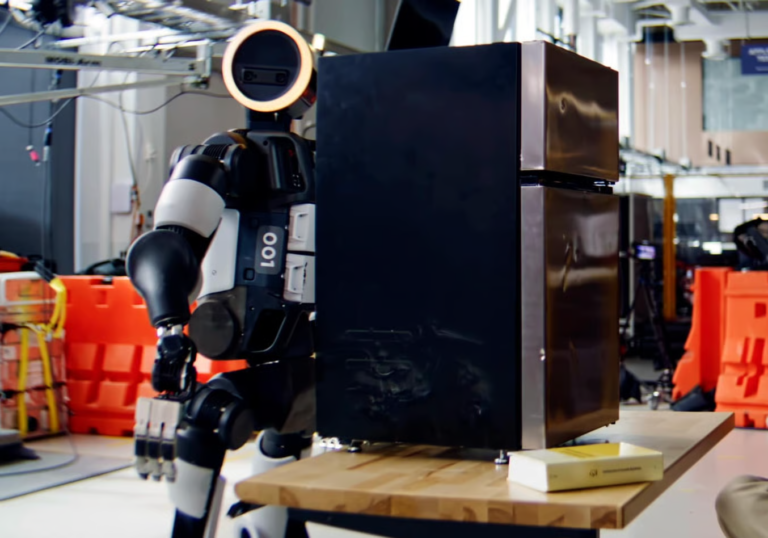
Robots Are Coming — but Not Everywhere

Getty Images
Humanoid robot technologies are advancing fast, but the pace of adoption may move less predictably. Each use case demands distinct technology to fulfill the robot’s specialized role. In geographic markets where humanoid adoption is most viable, demand will inevitably be determined by the unpredictable human response to this new tech.
“The ChatGPT moment for robotics is coming,” declared Nvidia CEO Jensen Huang at the Consumer Electronics Show in January 2025. It’s a widespread expectation: that humanoid robots will follow the same explosive adoption curve as generative AI. Our research suggests the opposite. Humanoid robotics will be adopted unevenly, across diverging use cases and geographies. Leaders need to reset their strategies for a more complex, jagged path to scale.
Humanoid robots are developing at pace. Engineering advances and new powerful models of physical intelligence, including vision-language-action models and improved locomotion systems, are converging to create a robotics super-cycle. But leaders who expect the path of humanoid adoption to mirror that of generative AI are misjudging the strategy required.
A Less Predictable Pace
Our research shows that three fundamental forces are shaping a very different adoption curve.
Force 1: No One-Size-Fits-All Model
Some humanoid manufacturers envision general-purpose robots working across multiple activities and industries. But for the foreseeable future, humanoid robots will not be commercially deployed as universal productivity tools.
Consider the multitude of roles that humanoids could theoretically take on: carer, guard, soldier, inventory picker, assembly line worker, hospital assistant, or concierge, to name but a few. Each role, and often each separate task of that role, imposes distinct and often incompatible requirements.
A warehouse robot, for example, may need to lift up to 132 pounds, requiring sophisticated actuators — the equivalent of human muscles — to complete its task successfully. Those actuator systems will make up 40% to 60% of its cost. But a care assistant robot requires different capabilities: subtle facial expression, fine motor control, and emotionally sensitive interaction. In this case, the technology build will tilt more heavily toward perception and haptic technologies. The diversity of humanoid roles implies fundamentally different technology build specifications, operating requirements, and ultimately, business cases for deployment.
Leaders who expect the path of humanoid adoption to mirror that of generative AI are misjudging the strategy required.
This divergence extends beyond the physical build into software and connectivity. A security robot will use low-latency edge-computing data processing close to its physical location — so it can rapidly respond to environmental changes, such as an incursion by an unknown person or vehicle. By contrast, a humanoid hospital assistant may rely on large graphical models to navigate hospital facilities and create 3D images of patient charts and X-rays.